
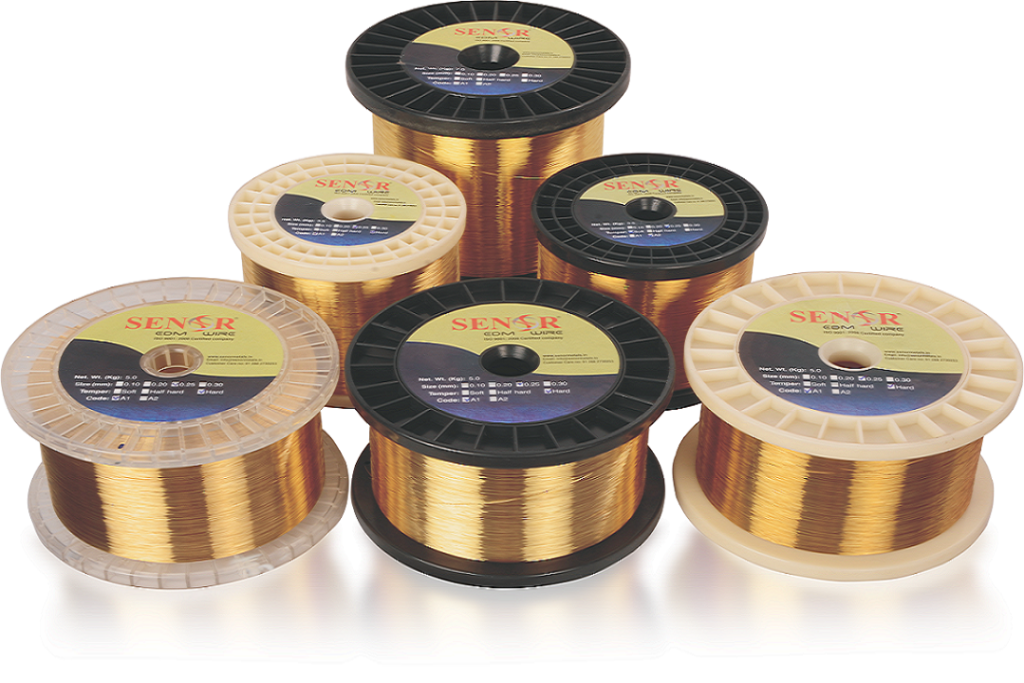
In EDM machining, wire is often treated as a consumable — something to be purchased at the lowest possible price. On paper, this seems logical. But on the shop floor, the reality is very different.
The actual question is not:
“What is the price of the wire?”
It is:
“What is the cost of using that wire?”
The Hidden Cost Behind Low-Priced EDM Wire :
Lower-priced EDM wires can appear economical at the time of purchase. However, their impact becomes visible during operation:
- Frequent wire breakage disrupts machining cycles
- Machine downtime increases due to repeated stoppages
- Cutting stability fluctuates, affecting surface finish
- Rework and rejection rates rise
Individually, these may seem minor. Collectively, they result in significant productivity loss and higher cost per component.
What Drives Consistent EDM Performance :
Reliable EDM performance is not accidental—it is engineered. A few critical factors determine how a wire performs in real conditions:
1. Material Purity & Conductivity
High-purity Copper (Cu) and Zinc (Zn) ensure uniform composition, enabling stable spark generation and efficient cutting.
2. Controlled Manufacturing Process
Technologies such as inline continuous annealing help maintain uniform tensile strength, which directly reduces the chances of wire breakage during operation.
3. Precision Testing & Validation
Accurate chemical analysis and tensile testing ensure that each spool performs consistently, rather than unpredictably on the machine.
4. Coating Consistency
Uniform zinc coating improves cutting stability and surface finish, while inconsistent coating can lead to uneven machining behavior.
5. Packaging & Handling Integrity
Even a well-manufactured wire can lose performance if not properly packed. Protection from moisture and handling damage is essential to maintain quality until use.
The Often-Ignored Cost Drivers
When evaluating EDM wire, focusing only on purchase price can be misleading. A more realistic evaluation considers:
Total Cost = Wire Price + Breakage Loss + Downtime Cost + Rework
- Lower-priced wire may reduce initial expense
- But higher breakage, downtime, and rework increase total cost Conversely:
- A higher-quality wire may carry a higher upfront price
- But delivers lower operational losses and higher productivity
A Shift in Buying Approach
Many experienced users are gradually shifting from price-based buying to performance-based evaluation.
The focus is moving toward:
- Consistency in machining
- Reduction in interruptions
- Output per spool
- Overall cost per job
This shift reflects a simple understanding:
Productivity, not price, determines profitability.
In Simple Terms
- Cheap wire may save money initially but causes more stoppages and losses
- Better-quality wire runs smoothly and produces more output
👉 Over time, the second option proves more economical
Question to ask : Are you Saving on Wire or Losing on Machine & Job?
Let us take a scenario to understand :
Cost Reality
- Machine Value: ₹50 lakh – ₹1 crore (Machine life at risk)
- Wire Consumption: ~50 kg/month
- Wire Price Difference: ₹30–₹40/kg (Premium vs Economy)
- Monthly additional cost of premium quality wire : Only ₹2,000 – ₹2,500
- Typical Job Value: In lakhs (Job at risk)
“A small saving on wire isn’t worth risking high-value machines and critical jobs.”
Summary
The real cost of EDM wire is not what you pay—it is what you lose or gain during machining.
Evaluating wire based on total cost rather than price leads to better decisions and improved shop-floor efficiency.
Manufacturers focusing on high-purity materials, controlled annealing, advanced testing, and consistent coating processes—such as SENOR—are able to deliver EDM wire that supports higher productivity and real cost reduction.
