
What Makes a Good Electrode Holder? And Why It Matters More Than You Think
In most welding shops, electrode holders are treated as a routine accessory—selected on price and replaced when they fail. But in reality, the electrode holder is a critical link in the welding circuit, directly influencing heat generation, operator safety, and overall efficiency.
Before choosing a brand, it’s important to understand what truly defines a good electrode holder—and why that foundation matters.
The Starting Point: Requisites of a Good Electrode Holder
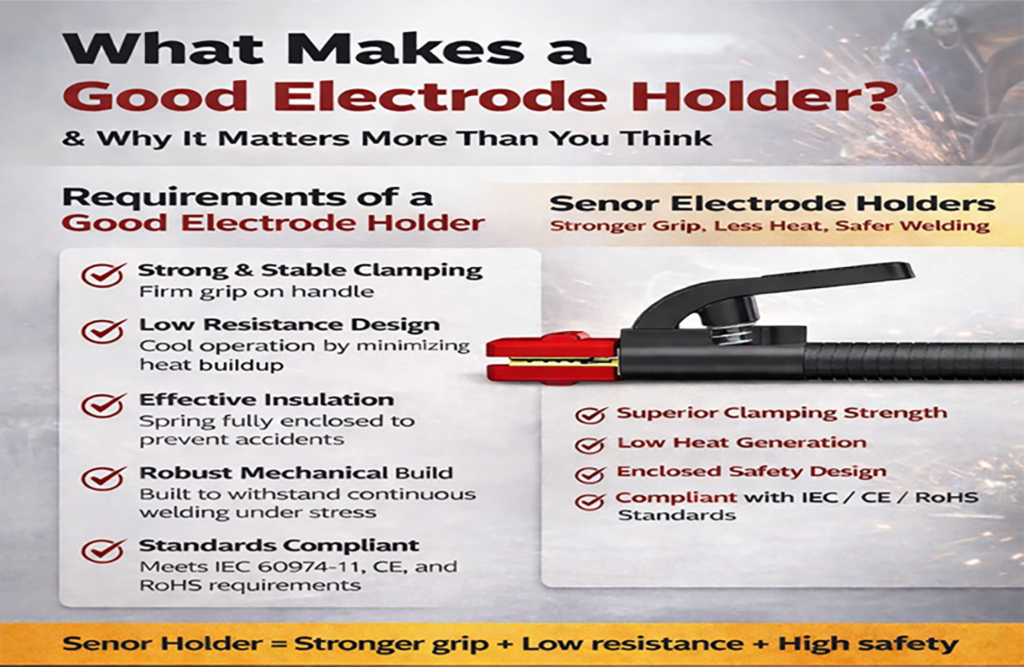
A high-quality electrode holder is not about appearance—it is about performance under load. Here are the essential requirements:
1. Strong and Consistent Clamping
The holder must grip the electrode firmly and maintain stable contact during welding.
Poor clamping leads to micro-gaps, causing sparking, instability, and heat buildup.
2. Low Resistance Current Path
Efficient current transfer is non-negotiable.
From a technical standpoint:
Heat ∝ I²R
Even a small increase in resistance (R) results in a sharp rise in heat. A good holder minimizes resistance at every connection point.
3. Complete Insulation for Safety
The design must ensure:
- No exposed live parts
- Full insulation of critical components
- Protection against accidental contact
This is not just a feature—it is a safety requirement.
4. Mechanical Strength at Stress Points
Frequent electrode changes and handling create stress at the handle and clamping joints.
A good holder must:
- Resist loosening
- Withstand repeated use
- Maintain structural integrity over time
5. Thermal Stability
The holder should operate reliably under continuous welding conditions without:
- Overheating
- Deforming
- Losing grip strength
6. Compliance with Standards
A dependable electrode holder aligns with:
- IEC 60974-11
- CE safety norms
- RoHS requirements
This ensures tested and certified performance.
The Reality: Where Conventional Holders Struggle
Many conventional electrode holders in the market fall short because:
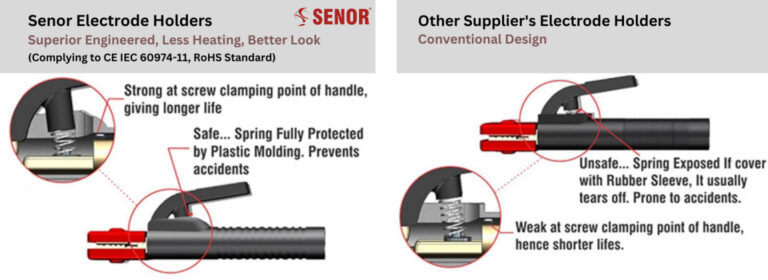
- Clamping points weaken over time
- Resistance increases due to poor contact
- Springs are exposed or loosely insulated
- Heat buildup accelerates wear and failure
The result is predictable:
Higher operating temperature, safety risks, and frequent replacement cycles
Bridging the Gap: How Senor Electrode Holders Redefine the Standard
This is where engineering makes the difference.
Senor electrode holders are designed by addressing each core requirement—not as add-ons, but as built-in features.
1. Strong Clamping That Lasts
A reinforced screw clamping mechanism ensures firm, stable contact—reducing resistance and preventing overheating.
2. Designed for Low Heat Generation
By optimizing the current path, Senor holders minimize resistance, which directly reduces heat buildup during operation.
3. Material Engineering for Maximum Conductivity
Senor engineers its electrode holders using the right conductive materials such as brass, combined with adequate size and weight of components to minimize resistance
The use of brass ensures near 100% current transmission to the electrode, reducing power loss and heat generation significantly
4. Safety Built Into the Design
Unlike conventional designs, the spring is fully enclosed within molded insulation.
This eliminates exposure risks and significantly improves operator safety.
5. Built for Durability
Critical stress points are strengthened to handle repeated use without loosening or failure, ensuring longer service life.
6. Ergonomics: Designed for the Welder
Senor offers 7 different electrode holding angles, allowing welders to choose the most comfortable working position
Every welder has a preferred angle—this flexibility improves control, reduces fatigue, and enhances weld quality.
7. Certified and Compliant
Senor electrode holders are designed in line with IEC 60974-11, along with CE and RoHS standards—making them suitable for demanding industrial environments.
Better design → Lower resistance → Less heat → Safer and longer-lasting performance
Final Thought
Choosing an electrode holder should not be an afterthought. When you start with the right requisites and select a design that meets them effectively, the benefits are immediate:
- Improved safety
- Reduced downtime
- Lower long-term cost
Senor electrode holders demonstrate how the right engineering can turn a basic tool into a reliable, high-performance asset in your welding operations. See more
